

Into the abyss
They were men of a fierce ruler

We all love a few facts or fable from history. and truthfully so we have never deterred to listen to a good old legend with beers or rum by the side.
* this in no way a promotion of alcohol or any tobacco lased products. Please don’t consume them they are not good for you.
let’s say with chai (tea).
I was recently reading this brilliant book by our minister of external affair', Dr. S. Jaishankar called “The India way”. It is basically a book on the India way to deal with global policies, war of nations and geo politics. Somewhere I think it is an apt way to tackle things which you have no control in. You might think of friends & enemies, or allies & rivals but there no such things.
Also, with a vast history of centuries and written records, we need to be strategic… Strategic with even knowledge.
The politics and power always covered with a thin grey cloud of conspiracy theorist. There are many such whispers as the illuminati, or the 10 horsemen, and real secret societies like the free masons.
Yeti, bigfoot, UFO…etcetera…etcetera.
And for man, it has always been a topic of fascination. I have realized it to be a point of uncanny truth, and as humans for truths without proof are no truer than wheat on a barren land.
Enough of my rant. Let’s see what we have today, or shall we say who!
The trusted
“Your majesty.”
The fierce ruler turned to his most trusted advisor, standing at the entrance of the balcony, a scroll clutched in his hands.
“They have arrived,” advisor said, bowing. “all nine, as you requested.”
During the 261-262 BCE, an unprecedented battle was fought—historical accounts suggest over 100,000 soldiers were killed, while countless civilians died from wounds and disease. An estimated 150,000 people were forcibly deported.
This was the devastating carnage of a ruler to gather control. The bloodshed was so striking it painted a whole river crimson red. A war having such an effect on the emperor who ruled and left for the pain of men, and peace of self.
Emperor
The ruler I was almost sneakily (no so much, eh!) talking about here was Ashoka.
Ashoka fought the Kalinga war, to expand his empire and to take in the area or modern day Odisha into his control. The war was so gruesome, Daya River (aka Dhauli river) turned red due to the bloodshed.
Ashoka was deeply moved by the carnage and, after the war, renounced military conquests, embraced Buddhism, and adopted a policy of "conquest by dharma"
He ordered his most trusted Radagupta to gather nine men before he leaves to attain his oneness to the universe.
The Books
Each of the Nine was entrusted with a book of knowledge—a tome filled with secrets and discoveries considered too dangerous for public dissemination. Though the actual contents are shrouded in myth, here’s what many legends suggest they contained:
Propaganda and Psychological Warfare – Techniques of mind control and mass influence.
Physiology – Secrets of the human body, including deadly touch techniques and healing.
Microbiology – Possibly knowledge of advanced immunology and biotechnology.
Alchemy and Transmutation of Metals – Alleged mastery over the conversion of base metals.
Communication – Ways to communicate beyond language, possibly telepathy.
Gravitation – Secrets about antigravity and aerospace technology.
Cosmology – Insights into the structure of the universe, possibly even time travel.
Light – Mastery over light, optics, invisibility, and energy.
Sociology – Blueprint for perfect societies and civilizational stability.
These were the nine men of Ashoka.
Whispers Through the Ages
Over centuries, rumors have surfaced about sightings or activities of the Nine—sometimes in connection with unexplained technological feats or mysterious figures who possessed impossible knowledge.
When Alexander Fleming "discovered" penicillin in 1928, few knew of the ancient Hindu text that had described similar mold treatments centuries earlier. When Einstein revolutionized physics, he never spoke of the strange visitor who had briefly discussed concepts with him years before. When the Manhattan Project scientists raced to harness atomic energy, none noticed the subtle manipulations that ensured their work would produce just enough power to end one war, but not enough to destroy all life.
Fall through
"Show them to the Chamber of Whispers," Ashoka commanded. "No guards, no servants. None must witness this gathering."
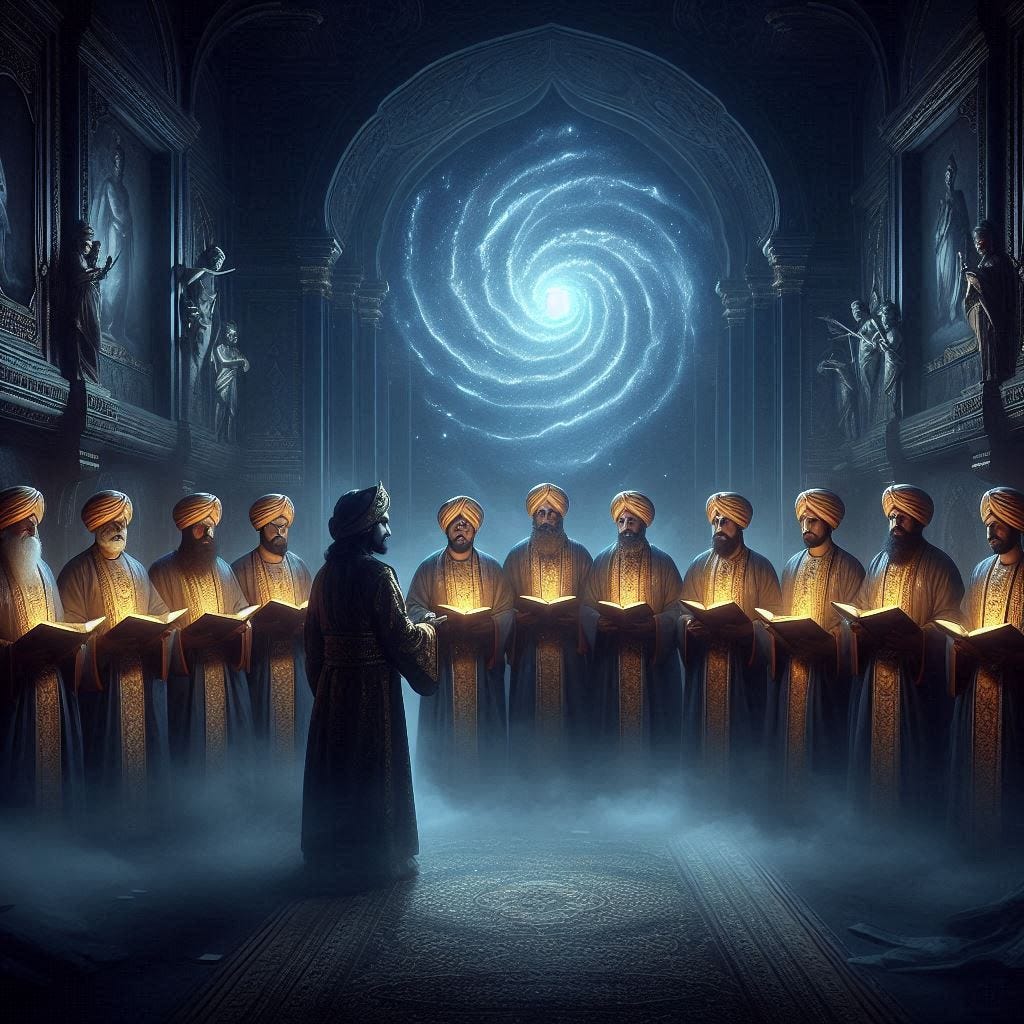
As Radagupta departed, Ashoka cast one final glance at his empire. Under his rule, the Mauryan dynasty had reached its zenith, stretching from present-day Afghanistan to Bangladesh. Roads connected distant provinces, universities flourished, and Buddhist principles guided governance. Yet a shadow loomed over these accomplishments – the knowledge that human ingenuity, left unchecked, inevitably led to destruction.
A legacy of shadows
There’s no historical evidence to prove the existence of the Nine Unknown Men. Ashoka’s inscriptions and edicts make no mention of such a group. Most of what we know comes from speculative texts, pseudohistory, and spiritual hearsay.
But legends survive because they resonate. In an age of information overload and scientific acceleration, the idea that a group safeguards dangerous knowledge is both reassuring and chilling.
Until next time… share and stay curious.